Center of Molecular Biology
Director
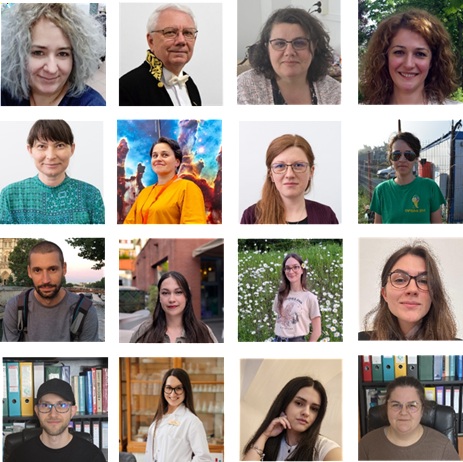
Associate Professor Beatrice Kelemen
beatrice.kelemen@ubbcluj.ro
Funding director: Professor Octavian Popescu, member of the Romanian Academy
Members
Associate Professor Iulia Lupan
Associate Professor Dorina Podar
Associate Professor Lujza Keresztes
Senior researcher Ioana Meleg
Assistant Professor Ioana Drăghici
Assistant Professor Cristina Mircea
Dr. Avar Denes Lehel
PhD student Martina Dondea
PhD student Diana Ilie
PhD student Francesca Sabău
PhD student Sebastian Oana
Master student Bianca Perţea
Mater student Erika Danel
Technician Oana Cazacu
Molecular Anthropology and Bioarchaeology
This research direction focuses on investigating genetic diversity in historical populations through the application of modern molecular biology methods to archaeological materials. The studies encompass both human populations and associated biological resources, such as domesticated animals and cultivated plants recovered from diverse archaeological contexts. The analysis of ancient DNA (aDNA) enables the reconstruction of population genetic structure, migration patterns, and kinship relationships, providing detailed insights into past population dynamics.
An important component of this research involves the study of microbiota associated with osteological remains and other archaeological materials, contributing to the understanding of interactions between host organisms and their microbiological environment. Such investigations can yield valuable information regarding the health status, diet and environmental conditions of historical populations, including the identification of infectious diseases and stress factors.
The integration of genetic data with archaeological and anthropological evidence supports a complex interdisciplinary approach, essential for reconstructing the lifeways of past communities. By combining molecular techniques with advanced analytical methods, this research direction contributes to a deeper understanding of human evolution, adaptation and interaction with changing environments over time.
Medical Genetics and Genetic Engineering
This research direction addresses the study of genetic mechanisms underlying organismal function, with direct applications in the medical and biotechnological fields. Research activities include the cloning of genes encoding proteins of interest using advanced recombinant DNA technologies, enabling controlled manipulation and expression of genetic material.
Through site-directed mutagenesis, genes can be specifically modified in order to investigate structure–function relationships at the protein level, providing insight into molecular mechanisms and functional domains. Another major objective is the overexpression of genes in host systems (e.g., bacterial or eukaryotic cells), followed by the purification of recombinant proteins and their biochemical and structural characterization.
These processes are essential for obtaining sufficient quantities of proteins for functional studies, diagnostic use or therapeutic applications. In addition, the research supports the development of molecular tools and strategies for gene-based investigations, contributing to advances in precision medicine and biotechnology.
Overall, this direction contributes to the development of novel diagnostic and therapeutic approaches, as well as to a deeper understanding of the molecular mechanisms underlying disease. It has a strong applied dimension, being highly relevant to biomedicine, pharmacology and industrial biotechnology.
Molecular Biology and Plant Physiology
This research direction explores the molecular and physiological mechanisms underlying plant–environment interactions, with a particular focus on the dynamics of heavy metals in plant systems. Investigations address the processes of uptake, transport, and accumulation of heavy metals, as well as the role of membrane transporters, especially those belonging to the facilitated cation diffusion transporter family.
A key area of interest involves the identification and characterization of heavy metal transporters in metallophyte and hyperaccumulator plants from spontaneous flora, species adapted to environments with high metal concentrations. In addition, interactions between plants and rhizosphere-associated microorganisms are examined, as these can significantly influence metal availability and mobility.
From an applied perspective, these studies support the development of phytoremediation strategies (the use of plants for soil decontamination) and biofortification approaches (the enhancement of plants with essential nutrients). Consequently, this research contributes both to environmental protection and to the improvement of food quality.
Insect Biology: Evolution, Ecosystems, and Behavior
This research direction approaches insects from an integrative perspective, encompassing evolutionary biology, ecology and behavioral biology. A central objective is the development of integrative taxonomy, combining morphological and molecular data for accurate species identification and classification. Such approaches are essential for biodiversity assessment, particularly in complex and understudied regions such as the Carpathian mountain range.
The use of molecular data in phylogenetic studies enables the reconstruction of evolutionary relationships among species and the identification of biodiversity reservoirs, contributing to a better understanding of speciation processes and historical biogeography. In parallel, research in behavioral biology focuses on host–parasite and species interactions, providing insights into mechanisms of adaptation, coevolution and ecological dynamics.
This direction has significant implications for biodiversity conservation and ecosystem monitoring, as well as for understanding the functional roles of insects within ecological systems. By integrating multiple levels of analysis, from molecular to organismal and ecological, the research contributes to a comprehensive understanding of insect diversity, distribution and ecological significance.
Research directions
Research infrastructure
Insect Biology: Evolution, Ecosystems, and Behavior
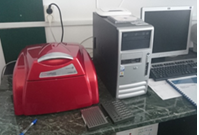
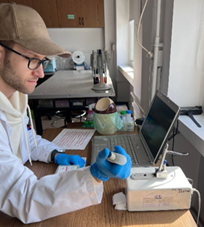
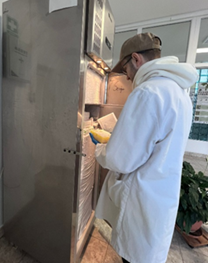
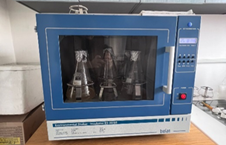
Fully equipped for advanced molecular work, these laboratories support a wide range of sample preparation and processing workflows essential for nucleic acid and protein studies. The facilities include microcentrifuges (with and without cooling), shakers, thermoblocks, incubators and hybridization ovens, enabling precise control of experimental conditions. NanoDrop spectrophotometers allow rapid quantification of nucleic acids and proteins, while precision pipettes and analytical balances ensure accurate sample handling and preparation.
Dedicated cold storage systems, including refrigerators and ultra-low temperature freezers (-20°C / -80°C), provide secure preservation of biological samples and reagents
Together, these laboratories ensure reliable and reproducible preparation steps for downstream molecular analyses.
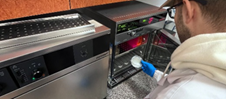
Bacterial Growth and Analysis Laboratory
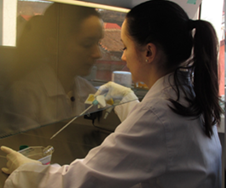
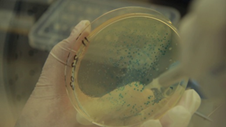
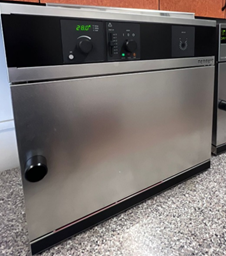
Designed for microbiological research, this laboratory provides controlled environments for bacterial cultivation, manipulation and analysis. It is equipped with laminar flow hoods (2 units) to ensure sterile working conditions, incubators and water baths for controlled growth, and an ultrapure water system for high-quality
The facility also includes a refrigerated benchtop centrifuge, electroporator for genetic transformation, and a UV-VIS spectrophotometer for monitoring bacterial growth and metabolic activity. Autoclaves and orbital shakers support routine microbiological workflows, while the ice machine and dedicated cold storage systems ensure proper sample handling and preservation. These capabilities enable both routine microbiological procedures and advanced experimental studies in molecular biology and biotechnology.
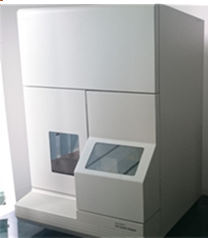
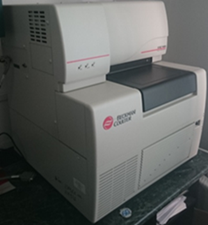
Nucleic Acid Analysis Laboratory
A fully equipped space dedicated to DNA and RNA analysis, supporting a wide range of molecular biology applications.
The laboratory includes PCR cabinets, thermocyclers and real-time qPCR systems for amplification and quantitative analysis, as well as horizontal electrophoresis equipment for nucleic acid separation.
Transilluminators and gel documentation systems enable visualization and accurate recording of results, while Sanger sequencing capabilities provide reliable sequence determination.
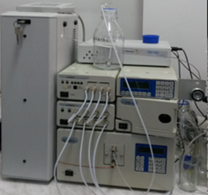
Protein Analysis Laboratory
This laboratory supports protein characterization and biochemical analysis through a range of dedicated instrumentation.
It is equipped with vertical electrophoresis systems for protein separation, thermoblocks for controlled incubation processes, and spectrophotometers for quantitative analysis. Fraction collectors and chromatography columns enable protein purification and separation workflows, supporting detailed investigation of protein composition and behavior
Eukaryotic Cell Culture Laboratory
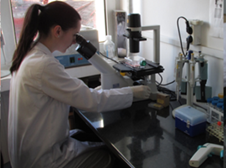
A modern facility for cell biology research, providing controlled conditions for the cultivation and manipulation of eukaryotic cells. It is equipped with Class II laminar flow hoods, aspiration systems and CO₂ incubators for sterile handling and optimal growth conditions.
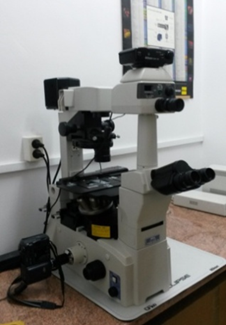
An inverted microscope enables routine monitoring of cell cultures, while refrigerated centrifuges (benchtop and micro) support sample processing. Liquid nitrogen storage systems and cold storage units ensure safe preservation of cells and reagents.
Microscopy Facilities
High-quality imaging is supported by advanced microscopy equipment, including an inverted microscope (Nikon Eclipse TE 2000S), enabling detailed cellular and molecular observations.
The system allows real-time monitoring of cell morphology, growth and behavior under controlled conditions.
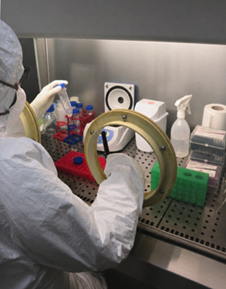
Ancient DNA Processing and Analysis Laboratories
Specialized laboratories designed for the study of ancient DNA, providing controlled environments for the extraction and analysis of highly degraded genetic material. The facilities feature positive air pressure systems with UV sterilization, UV lamps and air filtration to minimize contamination risks, along with PCR workstations and UV cross-linkers for secure molecular processing.
The laboratories are equipped with refrigerated centrifuges, incubators, gradient and standard thermocyclers, as well as electrophoresis systems, transilluminators and gel documentation units for nucleic acid analysis.
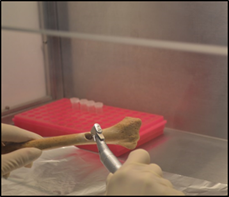
Analytical balances and dedicated tools for molecular anthropology support the sampling and processing of bone and dental materials, enabling reliable studies in archaeogenetics and evolutionary research
Research directions
RESEARCH PROJECTS
- PN-IV-P2-2.1-TE-2023-0570, Drăghici Ioana, Interpersonal and interpopulation affinities in historical communities illustrated through genetic and ecologic signatures (Echoes)
- PN-III-P1-1.1-PD-2021-0634, Drăghici Ioana, A glimpse into the past: maternal genetic diversity of a historical population with unknown cultural background from Romanian archaeological context (ArchaeoGen)
- PN-III-P1-1.1-PD-2019-0829, Denes Avar Lehel, The Danube Blossoms Again: The Importance of Pontic Refugia in the Recovery of the Most Endangered Mayfly in Large European Rivers – A Population Genetic Approach to Palingenia longicauda (Olivier)
RECENT ARTICLES
- García-Vázquez, A., Golea, M., Mircea, C., Cârciumaru, M., Sava, G., Ilie, A., & Lazăr, C. (2025). Old Collections, New Perspectives: Analytical Reassessment of One of Europe’s Biggest Archaeological Broomcorn Millet Deposits (Romania). bioRxiv, 2025-11.
- Stoean, B., Lupan, I., Cristea, C., Silion, M., Silaghi-Dumitrescu, L., Silaghi-Dumitrescu, R., & Gaina, L. I. (2024). Outcomes of folic acid esterification upon the properties of hydrophilic phenothiazinium dyes: New photosensitizers for antimicrobial photodynamic therapy. Journal of Photochemistry and Photobiology A: Chemistry, 451, 115500.
- Paica, I. C., Rusu, I., Popescu, O., Brînzan, A., Pencea, I., Dobrinescu, C., & Kelemen, B. (2023). Tentative indicators of malaria in archaeological skeletal samples, a pilot study testing different methods. International Journal of Paleopathology, 40, 109-116.
- Văcar, C. L., Ciorîță, A., Tudoran, C., Podar, D., Carpa, R., Leoștean, C., … & Mircea, C. (2023). Compact cold atmospheric pressure plasma cleaner suited for inhibiting bacterial biodeteriogens from paper archives. Journal of Cultural Heritage, 62, 198-205.
- Rusu, I., Paica, I., Vulpoi, A., Radu, C., Mircea, C., Dobrinescu, C., … & Kelemen, B. (2019). Dual DNA-protein extraction from human archeological remains. Archaeological and anthropological sciences, 11(7), 3299-3307.
Description of articles above
Recent publications highlight the center’s interdisciplinary activity at the interface of molecular biology, archaeology, heritage science and biomedical research.
Studies on archaeological materials focus on the reassessment of ancient plant remains and human skeletal samples, providing new perspectives on past environments, diet and disease. This includes analytical approaches for identifying malaria indicators in skeletal remains and advanced protocols for dual DNA–protein extraction from archaeological specimens, enabling improved biomolecular investigations of ancient populations.
Complementary research explores the application of plasma-based technologies for the preservation of cultural heritage, demonstrating effective strategies for inhibiting microbial degradation in paper archives.
In parallel, work in the field of photochemistry and biomedical applications investigates the development of novel photosensitizers for antimicrobial photodynamic therapy, highlighting the role of molecular design in enhancing biological activity and therapeutic potential.

